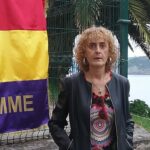
Balbina Rebollar, president of the Spanish Amical Neuengamme, tells the story of her father, Evaristo Rebollar.
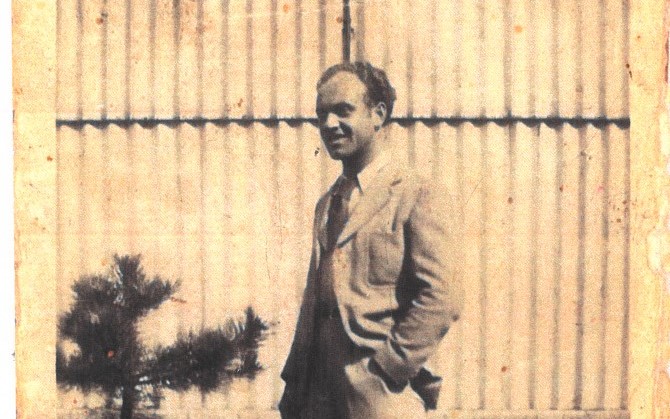
Evaristo was born on June 30, 1917, in the fishing village of Tazones in the district of Villaviciosa, Asturias. His parents were Eulogio Rebollar Estrada and Balbina Fernández Martínez. He was the second of four children – with Salvador, Flor María, and Balbina. From early childhood, he worked alongside his father and older brother as a fisherman. The family has always been committed to progressive ideas; they thought democratically and republicanly. Evaristo was a member of the C.N.T., and his brother belonged to the U.G.T. (both left-wing trade unions).
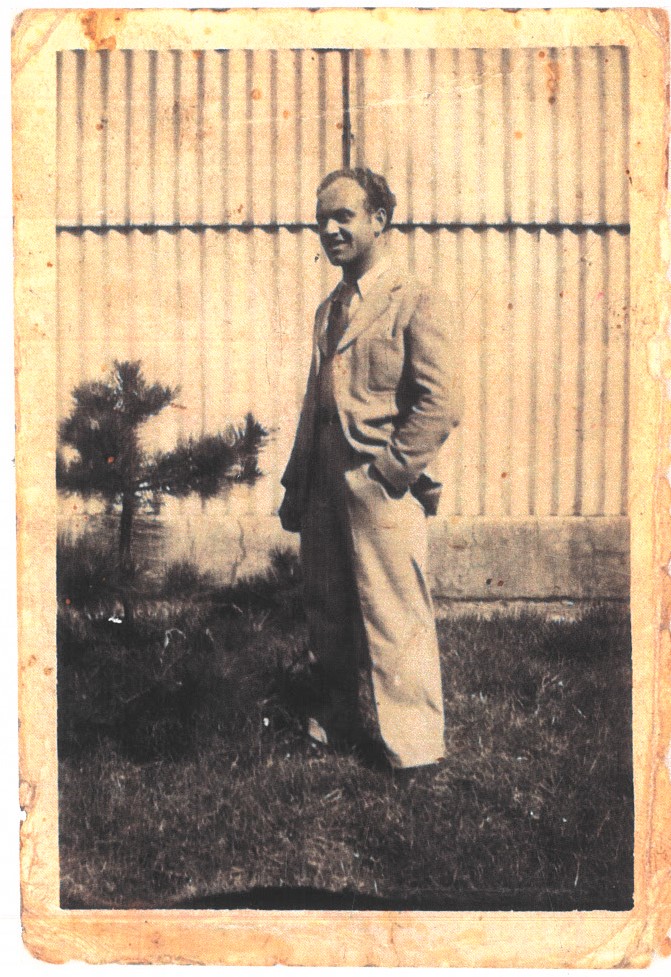
© Balbina Rebollar
His father was politically persecuted and eventually shot on March 3, 1938, at the Sucu cemetery in Gijón. His sister Flor, who was just a young girl at the time, had her hair shaved off before being arrested and imprisoned in Villaviciosa under threat of being shot like her father. Salvador, the older brother, served in the Navy on the destroyer “Antequera,” fighting for the legitimate government of the Spanish Republic, and was killed in 1943 in Africa (Sousse) during a German air raid.
Evaristo joined the fight against Franco’s rebel troops on the northern front. At the age of twenty, after the fall of Asturias in October 1937, he made his way to Catalonia. He served in the 56th Infantry Brigade and was wounded by a grenade in Torres del Segre, losing two toes. During the campaign, he was promoted to the rank of sergeant in the Republican Army. Evaristo was one of the 500,000 Republicans who fled to French exile during the “Retirada,” driven by the unstoppable advance of Franco’s forces. On February 6, 1939, he crossed the border at Port Bou with the surviving members of his brigade.
As a refugee, and still recovering from his injuries, Evaristo was interned in the Argelès-sur-Mer camp, where, like all Spanish Republicans, he had to endure extremely harsh conditions, as initially there was nothing but sand and sea. On April 29, 1939, he enlisted in the 10th Company of “foreign workers,” which was tasked with building a road in the Parpaillon Massif in the French Alps. With the same company, he was then deployed to fortify the Maginot Line in northern France, specifically in Ars-sur-Moselle. Until June 14, 1940, he worked there on strengthening the French fortifications. On that day, he left the company and made his way to Marseille, where he found refuge in the Mexican consulate. In May 1941, he set off for the German-occupied zone in northern France, presumably to carry out an operation on behalf of the French Resistance.
On July 22, he was arrested, along with another Spaniard, at the Varois train station by gendarmes of the Vichy regime. During the interrogation, Evaristo did not reveal his real name, but only gave his nickname, “Tomás Sáez Zapata,” which he would continue to use as a deportee on his way through France and Germany. On July 29, 1941, he was transferred to the high-security prison in Clairvaux near Dijon and from there, in September 1942, to the concentration camp in Rouille and then to Voves, again to a camp. There was an escape attempt by 42 prisoners, after which the SS took control of the camp. All prisoners, including Evaristo, were transferred to Compiègne-Royallieu. He arrived there on May 11, 1944, and was given the number 35388 under his alias “Tomás Sáez Zapata.”

© Balbina Rebollar
Ten days later, on May 21, 1944, he was loaded onto one of the convoys, known as “death trains”, along with more than 2,000 other men, which deported them to the Neuengamme concentration camp near Hamburg. They arrived exhausted and half dead from thirst after three long, agonizing days; many of them had not survived it. The prisoner Evaristo was given a new number: 32042, and was assigned to the “earthworks” commando as a slave laborer. Later, he was transferred to the subcamp Beendorf-Helmstedt, an old salt mine near Hanover. There, as part of a secret project called “Bulldog,” the SS had created underground workshops for the production of military equipment for the Luftwaffe. Evaristo worked in a shaft called “Marie”. In addition to the inhumane work, the conditions were harmful to his eyes and respiratory system, that by the end of his life he had almost gone blind.
On April 10, 1945, his command was evacuated ahead of the advancing Allied troops. Crammed into freight cars, they embarked on one of the infamous “death marches” and finally arrived at the Wöbbelin subcamp after six long days. By the end of the war, it had become a Nazi death camp, where thousands of prisoners died every day as a result of hunger, thirst, and disease. On May 2, it was liberated by US troops.
Evaristo was unable to return to Spain because of the Franco dictatorship, but was repatriated to France on May 19 and taken to recreation center north of Paris.
Later, he worked in different places: in a factory and at a horse stud farm in Le Mens, Vierzon, Vicq sur le Nahon, at Miramax, …
At the age of 33, in November 1949, he finally set foot on Spanish soil again—thanks to the efforts and a guarantee from his sister Flor, as well as a decree dated March 10, 1949, which allowed those who had not committed violent crimes to return. Evaristo returned home to Tazones after 12 years of suffering and deprivation; but even then he had to go with some cousins to Vigo (Galicia), the only place where they were willing to give him a work contract.
After several more years, he finally managed to return to his village and start a family. He died on July 28, 1996, in Gijón.