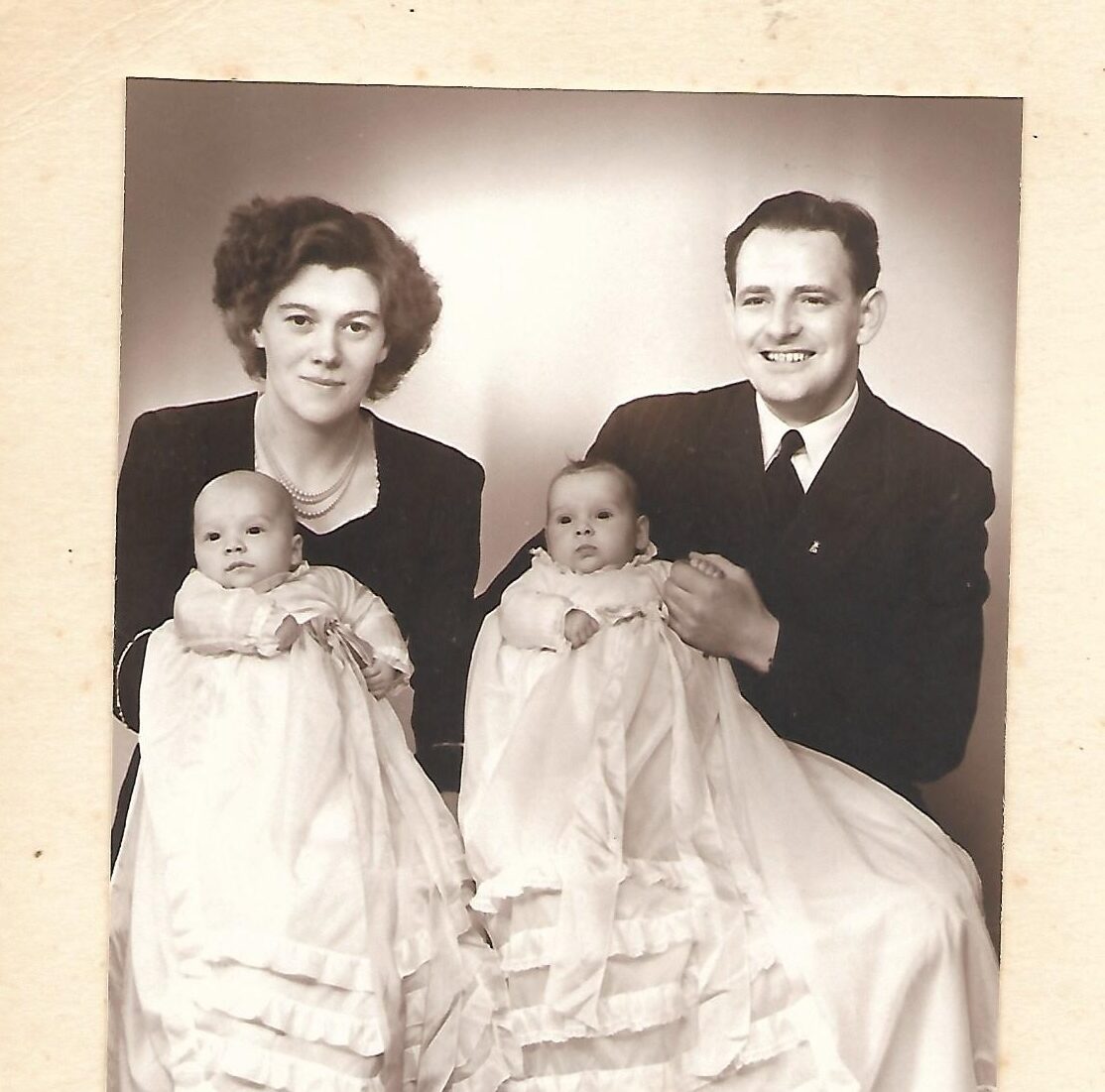
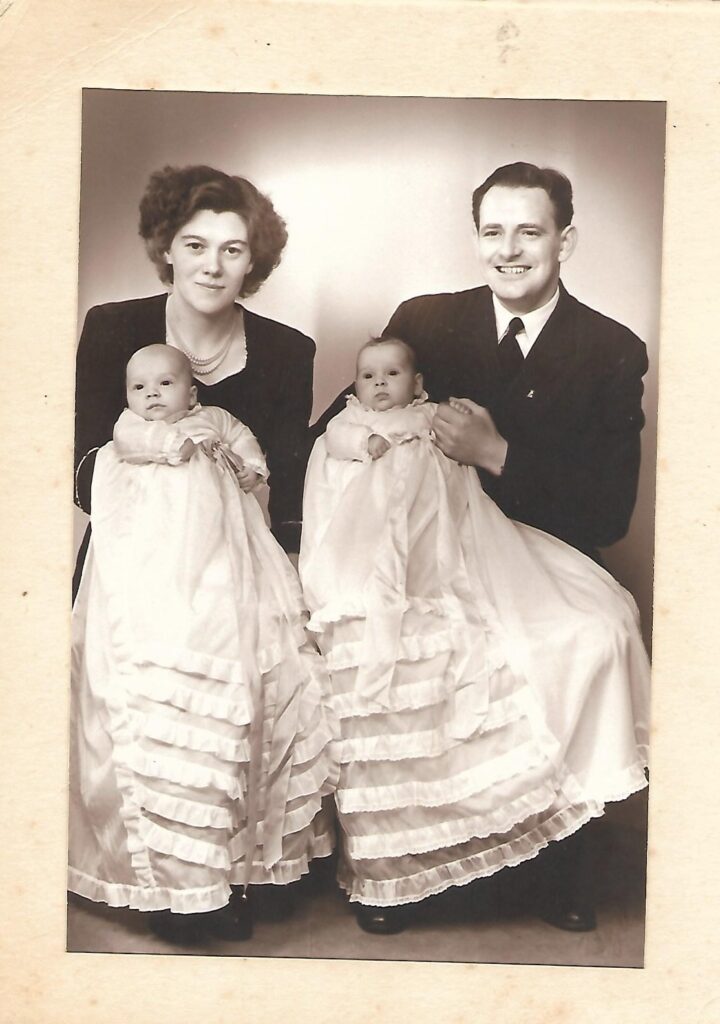
In 2021, I wrote an article about my father, Erik Holger Grome (Nielsen – the surname was dropped in 1961), his work in the resistance, his time in concentration camps and the period after the Second World War. This article was written for the reflections blog, I will therefore not repeat much here about the resistance work itself or his time in the camps but will instead say more about how it shaped our lives afterwards.
After my father returned home with the White Buses and following a period of rehabilitation in Sweden, he continued working as a postman in Copenhagen. His dream of continuing in the armed forces – he had become a non-commissioned officer (corporal) during his national service – and of continuing to play the trombone became impossible because of his damaged lungs. After the war, he spent two long periods in sanatoriums, where he fought tuberculosis.
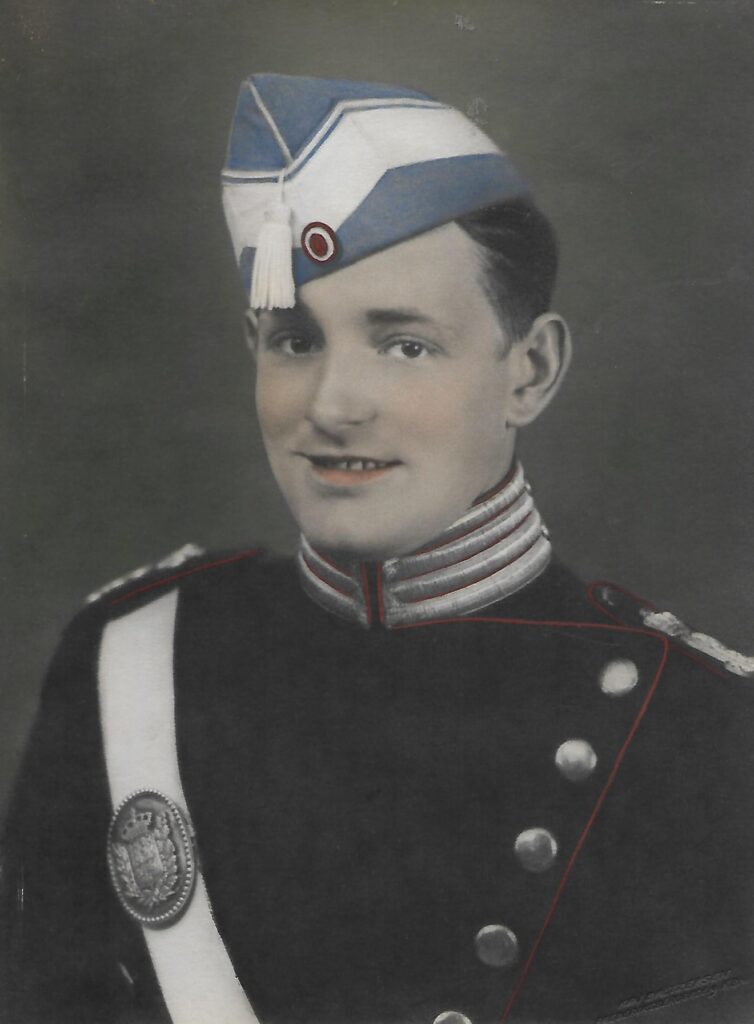
In 1948, he married our mother, Elly Marchen Kirstine Jacobsen, and in 1949 my twin brother Martin and I were born. These were austere post-war years – in Denmark too. Almost everything was rationed: coffee, milk, butter, infant formula, clothing and much more. We lived just outside Copenhagen in a small village where many things could be obtained by barter, including vegetables, eggs and chickens. We kept hens and ducks ourselves, and even a pig.
Although Father was on sick leave for long periods, there was never any question of dismissing him. He received his salary throughout, and it was a great source of security that he was a public-sector employee and was also protected by the state in recognition of his having been a member of the resistance and imprisoned in a concentration camp.
Mother was a diligent housewife. She and her aunt ran the home – a smallholding in Maglebylille. Mother had also trained as a dressmaker, so my brother and I never lacked clothes. They were often altered jackets or coats, but we did not mind when we were young. In fact, almost all the other children in the village wore altered clothes in the 1950s.
Psychological and physical consequences of the imprisonment
Our home was full of love. We were very rarely told off – we were probably very well behaved too – and violence was never used against us. During the first few years, we did not think much about our father’s way of life. But over time, we wondered how he could sit for hours, smoking cigarettes and simply staring into space. We were told that Father had been in the resistance, had been captured and sent with other resistance members to a labour camp in Germany, and that he needed to relax.
Only later, then, did we understand that our father had survived a concentration camp and therefore had to live for the rest of his life with serious psychological after-effects of trauma, which today might resemble or be consistent with PTSD. It took many years – both for him and for the Danish Neuengamme Association – to have the syndrome recognised. Fortunately, this was achieved in collaboration with skilled doctors. In my father’s case, the symptoms included:
- Nightmares and sleep problems – my mother said that he often woke drenched in sweat
- Anxiety, agitation and hypervigilance – a sudden sound could make him startle
- Depression or low mood – at one point he was admitted to a psychiatric ward for about a year
- Irritability or emotional withdrawal
- Difficulty talking about his experiences
- An impact on the family, because the trauma also affected everyday life at home
All things that we as a family came to feel later. Yet, strangely enough, we did not talk much about it. I truly admire my mother, who as his wife had to live with all of this while also holding everyday life together.
Because my father had tuberculosis, the whole family was closely monitored with X-ray examinations. These took place in a mobile X-ray clinic, which we visited several times a year to be screened. As a child, I felt that we sat in that vehicle waiting for hours – but that is probably my memory making the time seem longer than it really was.
Over time, I slowly came to understand the dreadful conditions our father had endured. I began reading a great deal about them, and I have also visited several former concentration camps. I can still barely understand how he survived. At the same time, I sensed that the Danish prisoners had a strong sense of solidarity and helped one another as much as they could. That must have made a great difference. It was of course also an advantage that Red Cross parcels reached them during the final six months of the war, and it was the Swedish Red Cross under Folke Bernadotte which, in cooperation with the Danish Red Cross, actually saved their lives with the White Buses.
From time to time, I took part in events and trips organised by the national Neuengamme Association, and there the veil was sometimes lifted a little on what conditions had been like in the concentration camps. Over time, there was greater openness, and some of the former prisoners spoke about their imprisonment – either in books or by giving talks. I have kept many of my father’s books, and several contain warm thanks to him for having given a talk at a school or educational institution.
It was my mother who made sure that my brother and I did our homework every day before we were allowed to go out and play. Father was not particularly involved in that part of daily life, but he willingly signed our school report books and attended parents’ meetings. Fortunately, we did quite well at school – perhaps because of good genes – and I think he was both proud of and pleased with our schooling and further education. But it was certainly my mother who bore the greatest responsibility for the home and our upbringing. Father was not very present at home, either physically or mentally. He was either ill or often had to lie down when he came home from work. And, of course, he also had his extensive work for the association. So we had to be very considerate of him – for example, by not making too much noise.
My father’s legacy
Father knew an incredible amount, and he had a memory like an elephant. He read widely, kept up with current affairs and had a particular gift for playing with language. He could turn words and sentences on their heads so that something funny suddenly emerged.
He was allowed to remain with us until he was 60 – by then we were 32. He died suddenly from a blood clot a few days before his 61st birthday. By that time, I had long since established a home of my own and was pregnant with his grandchild Peter, while my brother had lived and worked abroad for many years. I often wonder whether I might have learnt more from him if he had lived longer – and if I myself had questioned him more persistently about that period. But I have to admit that it probably would not have been possible.
I am proud of my father – of his work in the resistance, of his strength and of the fact that he survived imprisonment in a concentration camp.
But it certainly came at a price, both for him and for his immediate family. At times, I was also very worried about him, although as a child one does not fully understand what one is in the midst of. In his later years, he took quite a lot of medication, including antidepressants. He slept a great deal, smoked too much, gained a great deal of weight and self-medicated with alcohol.
But I am also impressed that after the war – and after so much illness – he became a company commander and captain in the Home Guard, drum major in the postal orchestra, and helped to establish the national Neuengamme Association in 1962. He was chairman of the association until his death.
Perhaps all of this contributed to my working in the health service for 51 years. Today I volunteer with, among other organisations, the Danish Heart Foundation, and for several years I have served on the board of the Danish Neuengamme Association. It is extremely important to me that the terrible events of the Second World War are not forgotten. And today that feels more important than ever.
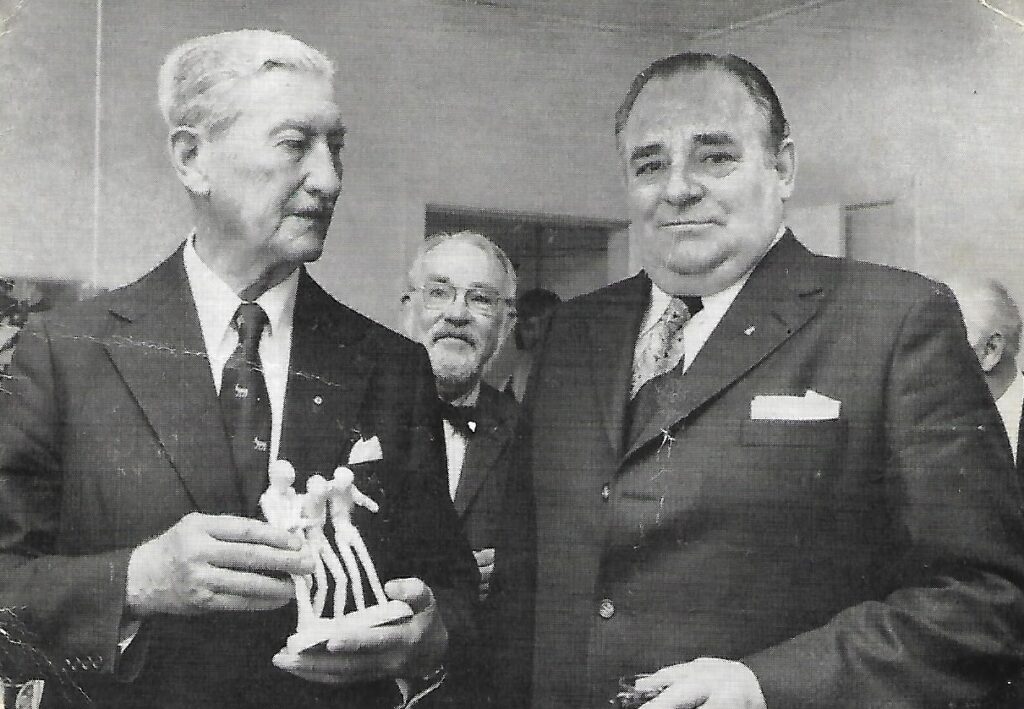
The association is a member of the AIN (Amicale Internationale de Neuengamme, often abbreviated to AIN). For several years, I have attended the annual meeting in Hamburg together with the association’s chairman. There I heard more about the dreadful conditions and atrocities that had occurred in countries such as Spain, France, the Netherlands, Belgium, Poland and Germany. Many people were killed or taken to concentration camps, and many towns were bombed to ruins.
I am deeply impressed by how well and soberly the Neuengamme Memorial is now presented, and by the many activities and public-information campaigns initiated there. Likewise, I am impressed by the many initiatives undertaken by the Neuengamme associations in the other countries, where they too ensure that the wartime period is not forgotten.
I am well aware that we in Denmark were spared much, as the country was not hit as hard during the war. Nevertheless, 6,100 Danes were deported to German concentration camps, and 600 of them died there.
But for those of us who have had a family member with profound and long-lasting after-effects – and who slowly succumbed beneath their weight – these atrocities naturally loom large. So I will repeat what my father taught me:
“We must not hate, but we must never forget either.”
